
What are neural networks? What do they have to do with AI?
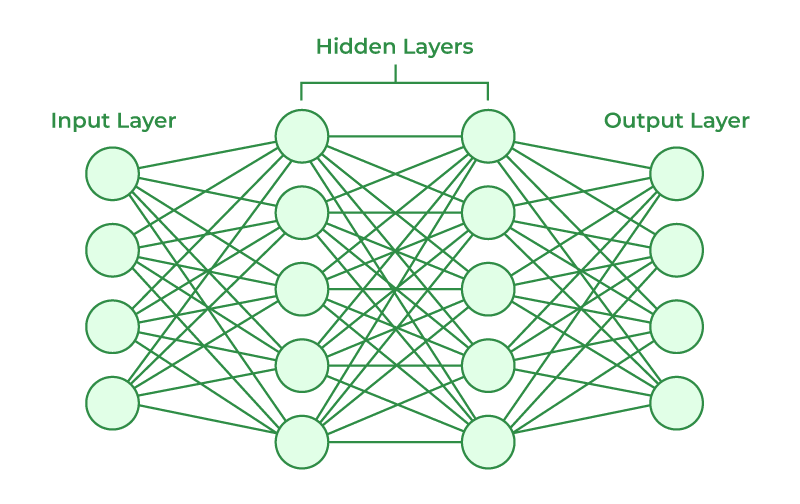
In general terms, a neural network is a system of algorithms that tries to mimic how humans learn. It’s made up of layers of nodes (also called neurons), which are connected to each other and pass information forward through the network. These nodes or neurons can be divided into 3 layers: the input nodes, the hidden layers, and the output nodes.
The input nodes are responsible for taking in data.
The hidden layers are where the data is processed. Each node applies a mathematical equation to the data that is received and passes it on. In general, the more nodes and connections that are present, the more efficient learning that will be done.
The output nodes produce the final interpretations or results of the data, and shown to human eyes.
Neural Networks and Machine Learning vs. the Brain
| Neural Networks – Basic units are nodes – Nodes are relatively basic; performs simple weighted sums – Transmitted signals are numerical values – picoseconds (FAST!!!) – Billions of node connections – Learn through: – gradient ascent – brute force – supervised learning (human-generated data | The Human Brain – Basic units are neurons – Neurons are complex with thousands of synapses – Transmitted signals are biochemical electrical signals – microseconds – 10^14-10^15 synapses – Learn through: – assumptions and models – different types of memory collection – Although neuron signals travel much slower than NN signals, the brain is able to learn much quicker (for right now) than NN’s, as we don’t have to look at something 1,000 times to finally learn something. This is due to the thousands of synaptic connections that human brains have. |